API Design Best Practices for B2B SaaS
API design best practices are the difference between an integration surface that wins partnerships and one that generates support tickets around the clock. This guide covers the patterns that matter most for B2B SaaS: contracts, versioning, rate limiting, webhooks, and the documentation habits that keep customer integrations stable as your product evolves.
Why API Design Breaks B2B Relationships
Poor API design creates ambiguity, and ambiguity costs you money. When your API contract is vague, your customers guess at the right input shapes, hit undocumented limits in production, and open support tickets that your engineers then have to triage instead of building.
A vague contract forces integrators to reverse-engineer your behavior. They ship code based on assumptions, and those assumptions hold up fine in staging. Then they break in production at 2am on a Tuesday. Missing rate-limit headers are a classic example: if you don't tell a customer how close they are to their limit, they only find out when they breach it. By then, someone's on-call and both engineering teams are scrambling.
Inconsistent response shapes compound the problem. If /orders returns { "data": [...] } but /invoices returns { "results": [...] }, every downstream consumer needs its own parsing logic. That's brittle code multiplied across every one of your integration partners. Unversioned endpoints make this worse. The moment you add a required field or rename a key, you've silently broken customers who were already live.
Error messages deserve their own callout. "Something went wrong" is not an error message. It's a shrug. A well-designed error response tells the integrator what failed, why it failed, and what they should do next. That distinction alone can cut your inbound support volume significantly.
Why This Matters Now: Integration Volume Doubles Every 18 Months
The pressure to integrate well has never been higher. Your customers now treat integrations as a core product expectation, not a nice-to-have, and every integration that quietly falls over takes a chip out of the retention you've worked hard to build.
AWS API Design Best Practices documentation points to this directly: as API call volume scales, even small design inconsistencies compound into large operational costs. Your support team ends up carrying the weight of your engineering debt. Every hour they spend explaining error codes that should have been self-explanatory is an hour not spent on higher-value work.
Competitors with well-documented, consistent APIs attract more integration partners. That's not a soft metric. More integrations mean more use cases, more stickiness, and a wider moat. Regulatory considerations add another layer: if you're handling customer data under SOC 2, HIPAA, or PCI frameworks, auditors expect formal API contracts, versioning policies, and audit logs. A handshake agreement about behavior won't hold up.
Most B2B product failures that get blamed on features actually trace back to integration failures. The product worked fine in isolation. It broke when it had to talk to something else.
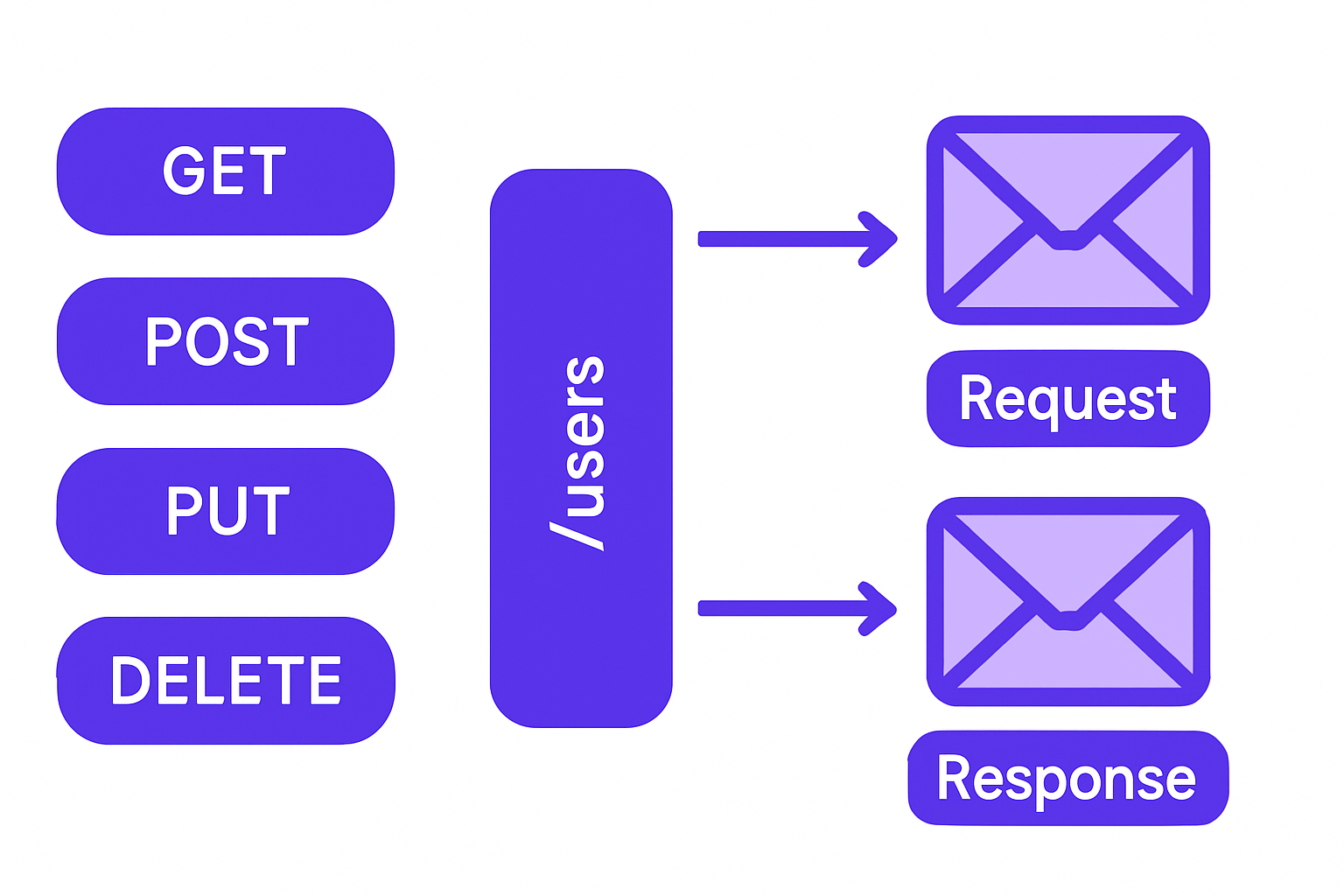
Diagram of REST API endpoint structure with HTTP methods and response shapes
The Core Principles: Contracts, Versioning, and Clarity
The foundation of good API design for B2B SaaS is treating your API as a contract, not a convenience. Every endpoint has a defined input shape, output shape, error codes, and a latency expectation. If you wouldn't put it in a service-level agreement, you haven't specified it clearly enough.
Design by Contract
Document every field. Type, nullability, allowed values, constraints. The OpenAPI Initiative maintains the industry standard for this: an openapi.yaml or swagger.json file that is the single source of truth for your API surface. Write the spec first, then generate the server stubs. That order matters. When you write the spec after the code, it becomes description. When you write it before, it becomes intention.
Version from Day One
Never ship an unversioned API. It sounds extreme until you need to make your first breaking change and realize you have no clean path. Use semantic versioning in your URL path (/v1/, /v2/) or in the Accept header. URL versioning is the more explicit choice for B2B integrations because it forces both your team and your customers to make a conscious routing decision.
REST API Best Practices, as outlined in RFC 7231, recommends running deprecated versions in parallel for 12 to 18 months before removal. Publish that schedule publicly. Customers building on your API have their own release cycles and their own change management processes. They need predictability.
Rate Limiting With Transparency
Set per-endpoint limits. Return X-RateLimit-Limit, X-RateLimit-Remaining, and X-RateLimit-Reset on every response. Give customers tools to stay under their limits before they hit them, not after. A customer who understands they're at 80% of their limit can throttle their calls. A customer who discovers the limit by breaching it files a ticket.
"The mark of a good API is not what it allows. It's how clearly it explains what it won't do."
Webhooks as First-Class Citizens
Webhooks often carry more operational weight than your polling endpoints. A customer needs to know the moment an invoice is paid, an order ships, or a status changes. Build retry logic with exponential backoff that persists for at least 24 hours, not just 3 attempts. Include HMAC-SHA256 signature headers so consumers can verify authenticity before processing the payload.
Implementation Patterns That Work
Concrete API design patterns separate APIs that scale from ones that survive their first few integrations before becoming a maintenance burden.
Resource-Oriented Endpoints
Model your API around the nouns your customers care about: orders, invoices, shipments, accounts. Use /orders/{id}/items instead of /getOrderItems. HTTP verbs carry the action semantics: GET reads, POST writes, DELETE removes, PATCH updates a subset of fields. When you blur this separation and start inventing verb-based endpoints, you force integrators to learn your vocabulary instead of the conventions they already know.
Async Patterns for Long-Running Operations
If a request might take more than a second, return a 202 Accepted with a Location header pointing to a status resource. Let the customer poll that resource or subscribe to a webhook for completion. Synchronous timeouts are a common failure mode in B2B integrations. Your customer's HTTP client has a timeout. Your operation doesn't. That mismatch breaks integrations that would have otherwise worked.
Pagination That Doesn't Break
Use cursor-based pagination with limit and after parameters. Offset pagination (?page=3&per_page=50) breaks when records are added or removed mid-query. A cursor is stable across mutations. Always include a has_more flag or a total_count so the client knows whether to keep requesting.
Errors That Explain Themselves
Return a consistent error shape every time: error_code, message, details, and timestamp. Error codes like RATE_LIMIT_EXCEEDED, VALIDATION_FAILED, or RESOURCE_NOT_FOUND allow customers to write defensive code that handles specific failure modes rather than catching generic exceptions. This is where the OpenAPI Initiative's schema validation tooling earns its keep. If your spec defines the error shape, your linter catches deviations before they reach production.
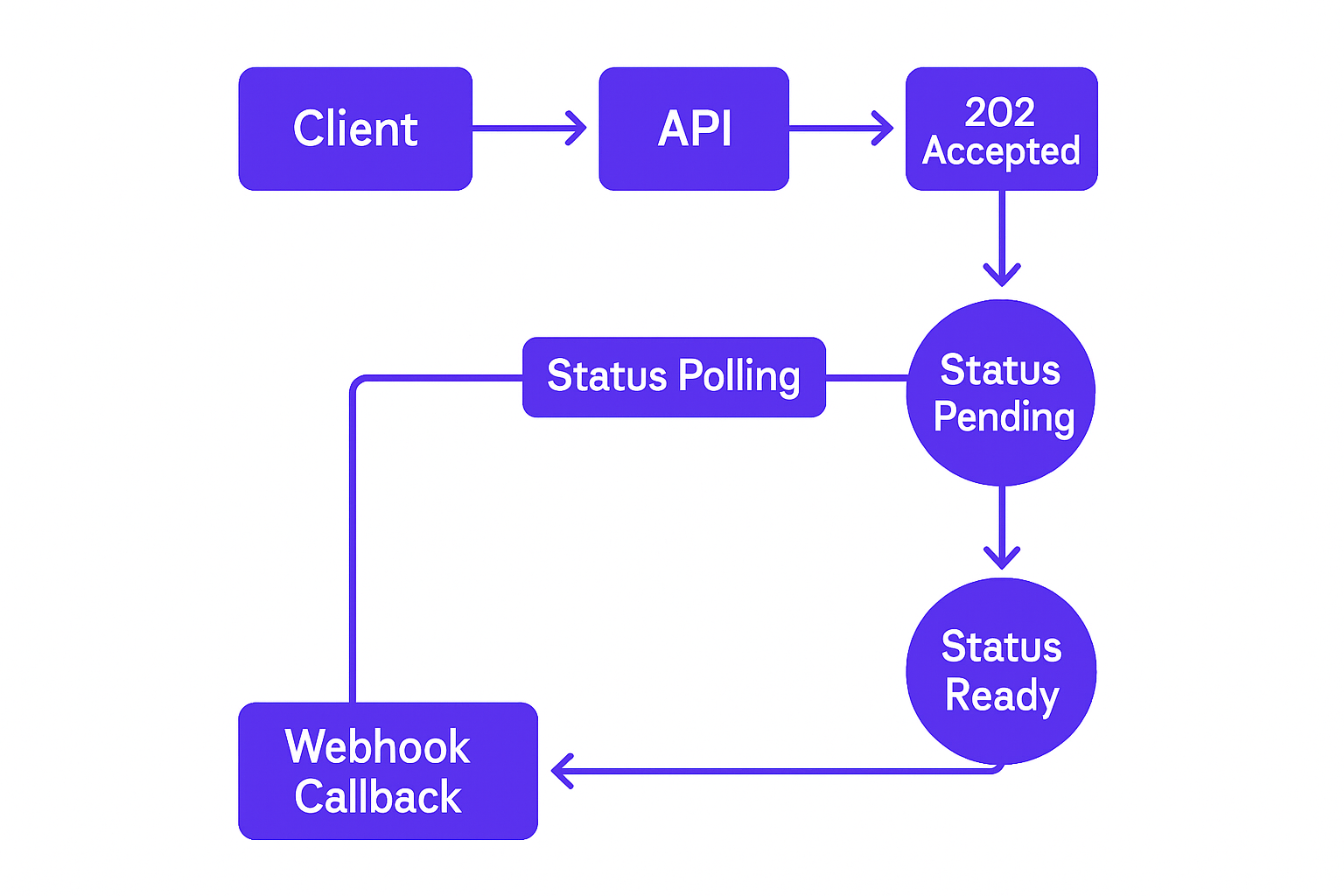
Flowchart showing async request handling and webhook notification pattern
Need API integration that actually scales?
Common Pitfalls That Kill Integrations
Even teams with good intentions ship APIs that frustrate their integration partners. These are the patterns that come up most often.
Inconsistent HTTP Status Codes
Returning 400 for one error type and 422 for another is an arbitrary distinction that forces integrators to handle both without knowing which to expect. Define your status code conventions once, document them, and apply them everywhere. The standard is clear: 2xx for success, 201 for resource creation, 4xx for client errors, 5xx for server errors. Stick to it.
Missing Timestamps
Your customer's system is processing your response 200 to 500 milliseconds after you generate it. Without created_at and updated_at timestamps on every object, they can't detect duplicates, handle retries safely, or identify stale data. Timestamps are cheap to add and expensive to retrofit.
Inconsistent Filtering Conventions
One endpoint uses ?query=X. Another uses ?search=X. A third uses ?filter[name]=X. Integrators building across multiple endpoints hit this and write bespoke handling for each one. Choose a single convention and apply it everywhere. If your querying needs are genuinely complex, consider supporting structured filters or look at whether GraphQL makes sense for that surface.
Webhook Retry Logic That Gives Up Too Fast
Three retries over five minutes isn't retry logic. It's optimism. Real-world integrations fail because of network blips, temporary downstream outages, and deployment windows. Retry for at least 24 hours with exponential backoff (1 minute, 5 minutes, 30 minutes, 2 hours, 8 hours, 24 hours). Log every attempt. Let customers see delivery history so they can diagnose failures without contacting your support team.
Documentation Out of Sync With the Code
This is the most common and the most expensive pitfall. Documentation written separately from the spec becomes wrong the moment the code changes. Automate it. Generate your docs from the openapi.yaml. Tools like Stoplight, ReDoc, and Swagger UI make this straightforward. If a developer has to choose between reading the docs and reading the code, you've already lost.
Next Steps: Audit and Evolve Your API
Start with your OpenAPI specification. If you don't have one, write it now from your existing endpoints. Treat it as the source of truth for contract, versioning, and deprecation timelines.
Run your spec through a linter. swagger-cli and Spectral both catch common inconsistencies: missing response schemas, undocumented error codes, inconsistent field naming. Fix these before they reach customers.
Test against real integration scenarios, not just happy paths. Simulate pagination edge cases, retry behavior under webhook failure, concurrent writes to the same resource. If your test suite only covers the success path, you're shipping integration debt.
Publish a changelog. When you deprecate behavior, announce it at least six months in advance. Customers have their own release cycles. Predictability from your side gives them time to adapt on theirs.
If your integration surface is complex, whether you're connecting to an ERP, a legacy billing system, or a network of downstream platforms, consider building a dedicated API layer that handles versioning, rate limiting, and monitoring outside your core product. This is where GroovyMark WebX's ERP & Legacy System Integration practice fits directly. We design and build API layers that translate between your system and your customers' workflows, so your engineering team isn't constantly maintaining adapter code when your product evolves.
For teams managing client-facing data, the pattern extends to the presentation layer too. A well-designed Custom Client Portal built on top of a stable API surface gives your customers a reliable interface to their data without your engineering team fielding custom data requests.
You can see how we've applied these patterns in practice across our case studies.
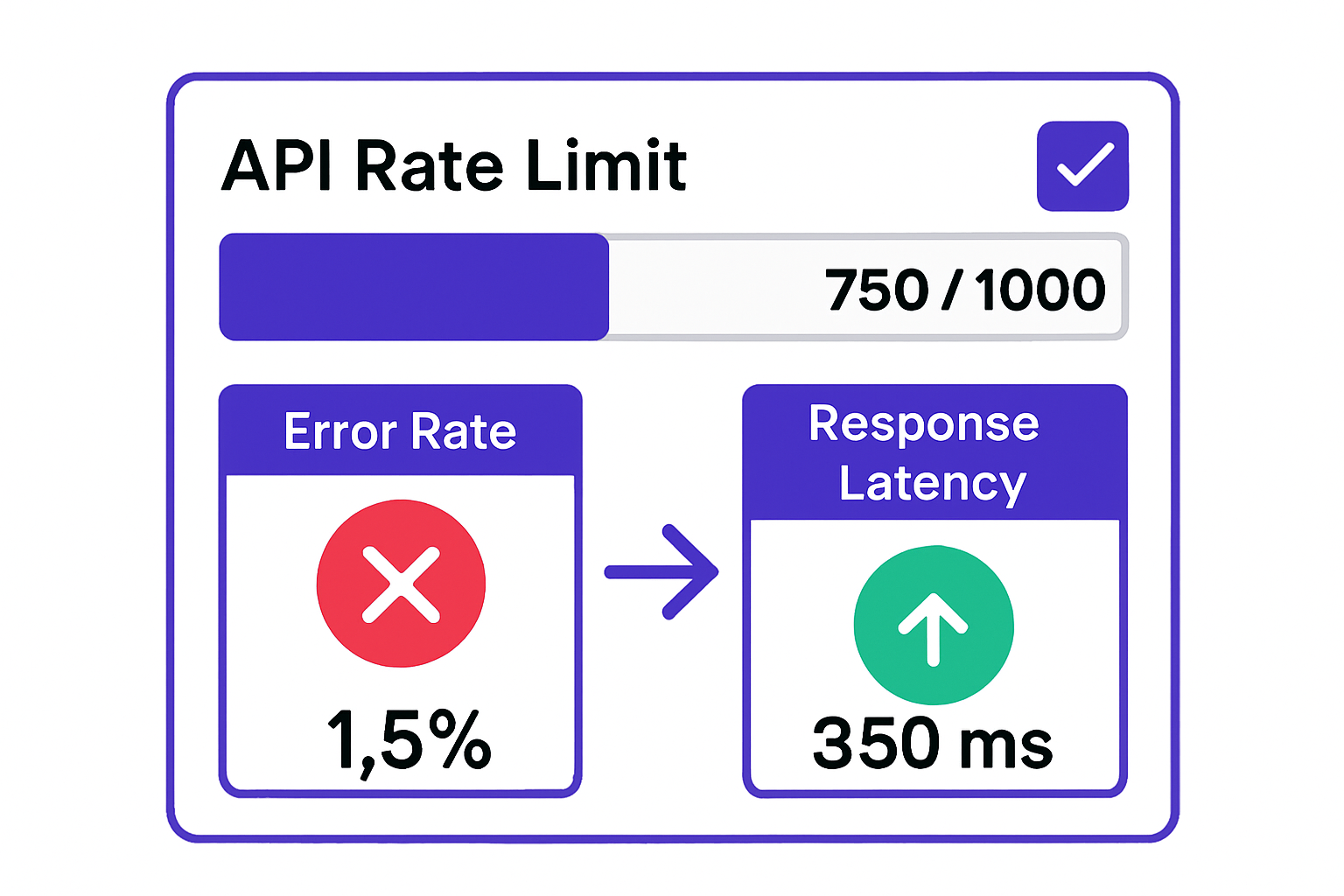
API metrics dashboard displaying rate limits, errors, and latency
Good API design isn't a one-time sprint. It's a discipline you build into how your team ships, versions, and retires endpoints. The teams that get this right spend less time in support queues and more time building the product features that actually drive growth.
If you're ready to audit your integration surface or build an API layer that can handle enterprise-scale demands, talk to our team about your integration roadmap. GroovyMark WebX works with B2B SaaS companies and agencies to get this infrastructure right the first time, so you're not rebuilding it when a major customer asks for it.
Ready to strengthen your integration strategy?
Frequently asked questions
What's the difference between API versioning in the URL vs. headers?
URL versioning (/v1/orders, /v2/orders) is explicit and easier for customers to route; header versioning (Accept: application/vnd.company.v1+json) keeps the URL stable. URL versioning is clearer for B2B integrations because it forces intentional decisions. Header versioning works if you're evolving slowly and need backward compatibility within a major version.
How should we handle breaking changes without breaking our customers?
Always version from the start. When you need to change behavior, publish the new version as a new endpoint or header value, then announce a deprecation date (typically 12–18 months). Run both versions in parallel during the overlap. GroovyMark WebX helps B2B companies manage this through ERP & Legacy System Integration — we build the translation layers that let you evolve your core system while keeping customer integrations stable.
What's a realistic rate limit for a B2B API?
It depends on your use case, but start with 100 requests per minute per API key, then monitor actual usage. Most B2B integrations live well under that. If a customer hits limits, it usually means they're polling when they should be using webhooks. The key is being transparent: return limit headers in every response so they know where they stand.
Should we document via Swagger, OpenAPI, or both?
Swagger and OpenAPI are the same thing — Swagger was rebranded to OpenAPI. Use OpenAPI 3.0+ and generate your documentation from the spec using tools like Stoplight, ReDoc, or Swagger UI. Never write documentation separately; it will rot. GroovyMark WebX builds API layers that are spec-first by design, ensuring documentation is always in sync with the live endpoints.
How do we prevent API abuse without blocking legitimate integrations?
Use per-key rate limits, not per-IP. Implement progressive backoff (warn at 80%, hard limit at 100%) and give customers visibility through headers. Add authentication (OAuth 2.0 or API keys with scopes) so you know who's calling. For high-volume customers, offer higher limits or async bulk endpoints. Consider requiring API keys even for read operations so you can track and protect legitimate users.