Security Compliance Frameworks for SaaS: What You Actually Need
Security compliance frameworks for SaaS are not one-size-fits-all, and most founders waste six figures chasing certifications their customers never asked for. This guide cuts through the noise: which frameworks you genuinely need, in what order to pursue them, and how to build a compliance architecture that earns enterprise deals without grinding your engineering team to dust.
The Compliance Paralysis Problem
The compliance paralysis problem is real: too many acronyms, no clear starting point, and consultants who profit from your confusion. SOC 2, ISO 27001, GDPR, HIPAA, PCI DSS. Each one sounds mandatory. None of them are mandatory for every SaaS company.
Founders routinely build compliance programs for a prospect they might never land. The enterprise deal sounds close, so you spin up a SOC 2 program, hire a consultant, buy a GRC tool, and task your two best engineers with documentation for three months. Then the deal falls through and you've got a $200k/year compliance stack with zero paying customers to justify it.
The timing trap makes this worse. You don't usually know which framework a customer requires until they ask. Then you have 90 days to prove it. That's not enough time to do it properly, so you either ship half-baked controls under pressure or lose the deal entirely.
The answer isn't to ignore compliance. It's to sequence it correctly.
Why Compliance Frameworks Exist (And Which Ones Actually Matter)
The security compliance frameworks SaaS companies encounter exist to give enterprise buyers independent proof that you handle data responsibly. Your marketing copy isn't enough. Your privacy policy isn't enough. Buyers want a third party to have verified your controls.
SOC 2 Type II is the dominant proof mechanism for B2B SaaS selling to enterprise buyers in the US and Australia. The American Institute of CPAs (AICPA) publishes the Trust Service Criteria that underpin SOC 2, and audits against those criteria are what enterprise procurement teams actually read. It covers logging, monitoring, access control, incident response, and availability. Land a SOC 2 Type II report and you can answer 80% of security questionnaires without custom responses.
ISO 27001 is published by the International Organization for Standardization (ISO) and operates as an information security management system. It's heavier than SOC 2, requires a formal management system and internal audit program, and adds significant ongoing overhead. It becomes genuinely necessary when you're selling to financial institutions, government agencies, or healthcare companies, especially in the UK, Europe, and parts of Asia. If your ICP doesn't include those buyers, you can defer it.
GDPR is a different animal entirely. The European Commission's General Data Protection Regulation isn't a security audit framework; it's a data-handling law. If you process data belonging to EU residents, you comply. Full stop. There's no opt-out based on company size or geography. GDPR requires you to handle consent, data deletion requests, and breach notification according to specific timelines, and it requires you to prove you did it.
HIPAA is healthcare-specific. PCI DSS applies when you store, transmit, or process cardholder data. Most SaaS founders don't need either until they enter those verticals, but when they do, they need them badly and retroactively fitting the controls is painful.
The three things your customers actually want to know: Can you prove you're secure? Can you prove you respond to breaches? Can you prove you delete their data when they ask?
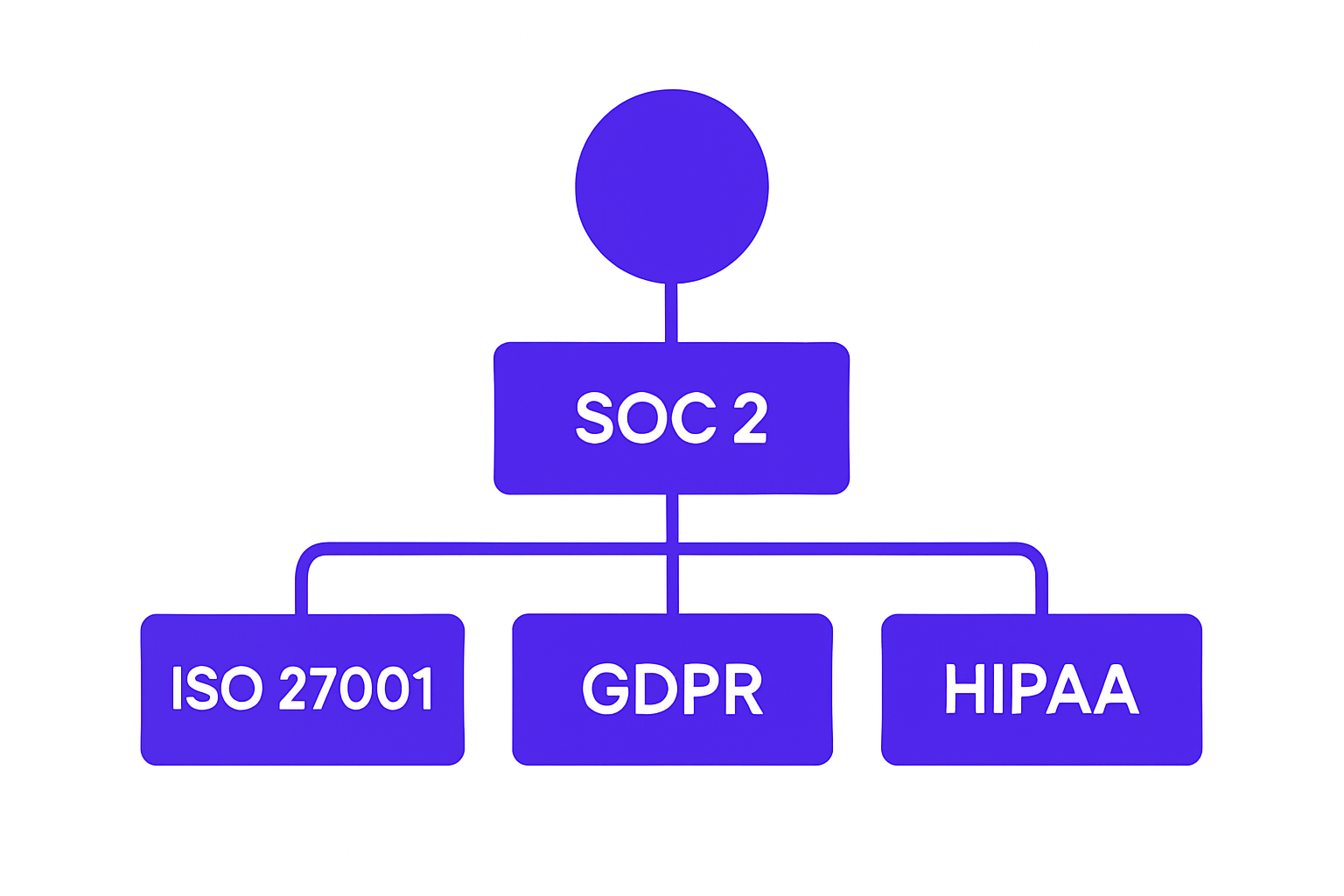
Comparison diagram of four major security compliance frameworks and their scope
The Framework Stack That Actually Works
The right compliance framework stack for most B2B SaaS companies starts with SOC 2 Type II, adds GDPR if you have EU customers, and layers ISO 27001 only when your target market demands it. That sequence covers the majority of enterprise deals without over-engineering your program.
Start with SOC 2 Type II. You need 6 to 12 months of operational history before an auditor will take you seriously, and the audit itself costs $15 to $30k in the first year. Budget 4 to 6 months to get your controls documented and proven. Most teams hit 60% of requirements already; the gap is usually logging completeness, access reviews, and written incident response procedures.
Layer GDPR data handling if you have any EU customers. This isn't a certification you earn; it's compliance you maintain. You need consent management, documented data retention schedules, a process for handling deletion requests, and a breach notification workflow that meets the 72-hour reporting window. If you're using a US-based infrastructure provider, you also need to sort out data transfer mechanisms.
Add ISO 27001 if your ICP demands it. Most use SOC 2 to enter US and ANZ markets, then pursue ISO 27001 to open European enterprise and regulated-sector accounts. The controls heavily overlap with SOC 2, so the incremental effort is mostly documentation and management system formality rather than net-new technical work.
Everything else depends on your verticals. HIPAA, PCI DSS, CCPA, FedRAMP: don't build for them speculatively. Build when a specific customer or market requires it and you've already closed enough revenue to justify the investment.
The architecture that holds all of this together is consistent across every framework: encryption at rest and in transit, access logging with tamper-proof storage, role-based access controls with annual access reviews, an incident response plan you've actually rehearsed, and annual penetration testing from an independent firm.
How to Build It Without Breaking Velocity
You can implement a solid compliance program without stalling product development, but only if you treat compliance as architecture rather than as a documentation project.
Start with an honest assessment of your current stack. You probably meet 60% of SOC 2 requirements already through good engineering habits. The gaps are almost always logging gaps, undocumented access procedures, and missing incident response paperwork, not missing technical controls.
Document how you actually operate. Not how you wish you operated. Auditors are good at spotting the difference between a policy that lives on paper and controls that live in your systems. Write the truth about your access management, your deployment process, your backup verification cadence. If you can't describe it precisely, you can't prove it.
Automate logging and monitoring before you do anything else. Manual compliance checking is how audits fail. Centralized logging that your team can't accidentally delete, alerting on unusual access patterns, and automated evidence collection are the foundation. Set it up once and it accumulates evidence continuously rather than requiring a compliance sprint every 12 months.
Hire a fractional CISO or compliance consultant for 3 to 4 months. This costs significantly less than rebuilding an incorrect compliance architecture after a failed audit. A good fractional CISO will identify control gaps, help you scope to your actual market requirements, and guide your first audit without turning it into a full-time internal role.
Run a Type I internal review before committing to a Type II audit. It surfaces real gaps without the legal exposure of a formal audit and gives your team a dry run at producing evidence.
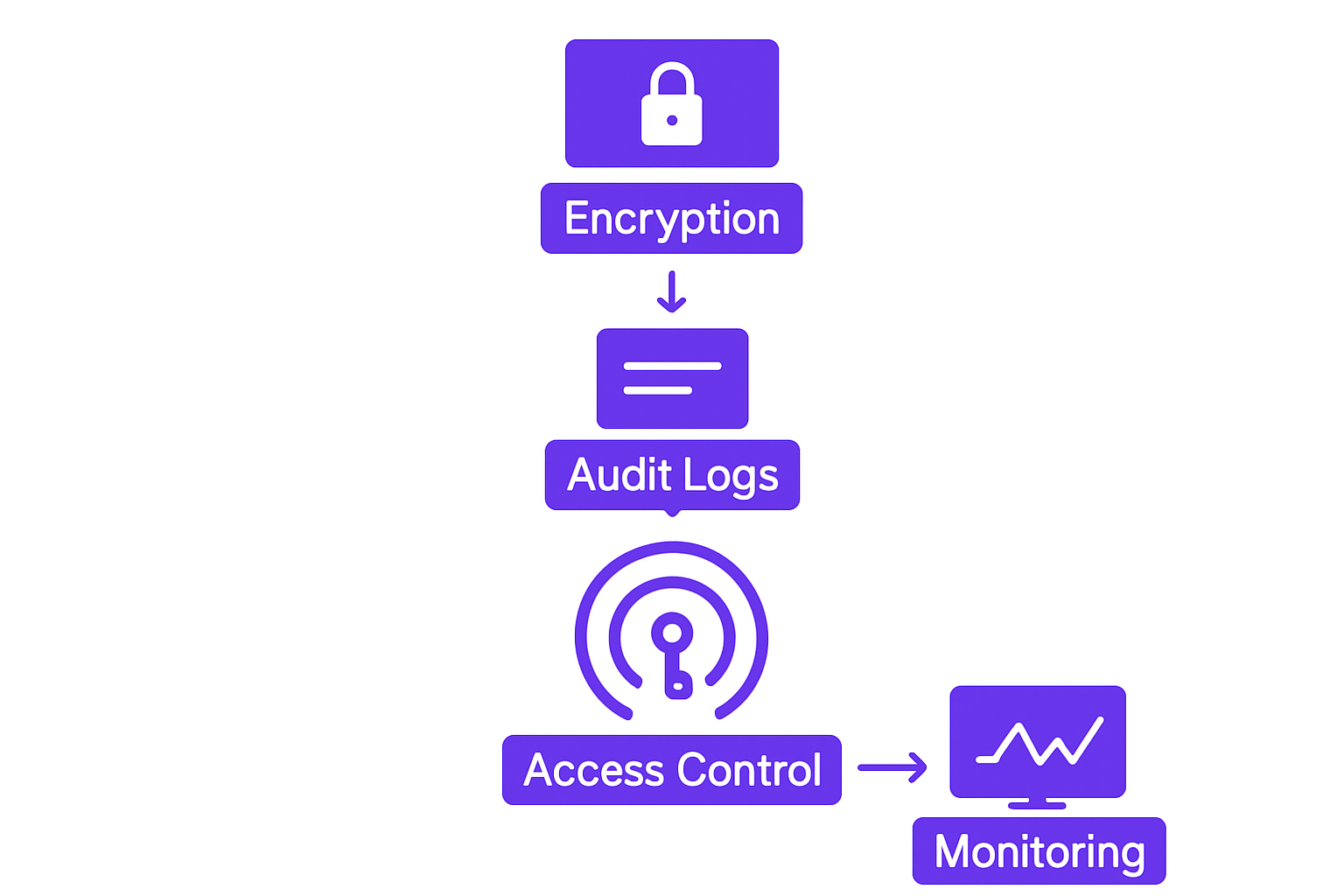
Layered security architecture showing data encryption, audit logs, and role-based access control
Compliance audit blocking your next deal? Let's scope it.
The Mistakes That Kill Compliance Programs
Most compliance programs fail not because the frameworks are too hard but because teams make predictable architectural and process mistakes that compound over time.
Treating compliance as a department, not an architecture decision. When you hire a compliance officer to own everything and your engineers treat compliance as someone else's problem, you end up with policies that don't match your systems. Compliance controls need to be owned by the people who build and operate the systems. It's an engineering concern, not a paperwork concern.
Over-documenting to look thorough. A 200-page security manual that no one reads is a liability in an audit. Auditors will ask your engineers questions based on that document. If your engineers haven't read it and don't operate that way, you fail. Write documentation that accurately reflects how you work, not documentation designed to impress.
Assuming one framework covers your entire market. SOC 2 Type II doesn't satisfy GDPR. ISO 27001 doesn't satisfy HIPAA. Each framework answers a different question for a different audience. Stack them intentionally based on the buyers you're targeting today, not the ones you might theoretically target someday.
Implementing controls that look good but break usability. MFA that developers route around, a VPN that kills productivity on the road, password rotation policies that result in sticky notes on monitors. Security theater creates audit risk and operational frustration simultaneously. Controls that don't actually work are worse than no controls because they give you false confidence.
Starting compliance only when a deal requires it. By the time a prospect asks for your SOC 2 report during procurement, you're negotiating under time pressure. You'll ship incomplete controls, document what you plan to do rather than what you do, and go into the audit with a weak evidence trail. The right time to start is when you close your first enterprise-tier customer, not when you're about to lose one.
Getting Help Without Losing Control
Compliance architecture works best when your team owns it and outside partners help you build it correctly. The mistake most founders make is treating compliance as something to fully outsource and then forget, and that approach always creates problems at audit time.
Look for partners who actually understand your system architecture and can embed compliance controls into your production environment rather than bolting them on afterward. Custom integrations that enforce security compliance from the design stage are materially easier to audit than systems where logging and access controls were added as an afterthought.
When you're scaling across regions, integrating legacy systems, or handling sensitive data flows across multiple services, compliance and architecture become inseparable. You need a partner who can reason about both simultaneously. That's not common.
At GroovyMark WebX, we architect compliance controls into integrations, portals, and data systems from the first design conversation. We don't retrofit security after the fact. We wire audit logging, access control, and data handling into the system architecture itself, so by the time you're ready for a formal audit, the evidence has been accumulating for months. See how we've helped SaaS companies get audit-ready without derailing their product roadmaps.
If you're not sure where your current architecture stands relative to the framework you're pursuing, the right move is a structured assessment before you commit to a program. Talk to us about your compliance roadmap and we'll tell you honestly what you have, what's missing, and what sequence makes sense for your market.
The compliance programs that actually work share one characteristic: they're built into the product, not layered on top of it. See what enterprise-grade architecture looks like when compliance is treated as a first-class design requirement rather than an audit-prep exercise.

Engineers collaborating on security architecture and compliance documentation at workstations
Building solid compliance architecture is achievable for any SaaS company willing to sequence it correctly and treat it as an engineering discipline. Start with the framework your next enterprise customer will actually ask for, build the controls into your systems properly, and let the evidence accumulate before you need it.
GroovyMark WebX works with B2B SaaS companies and digital agencies to build this infrastructure the right way from the beginning. If you're preparing for your first SOC 2 audit or untangling a compliance program that's grown too complex, contact us and let's scope what you actually need.
Ready to build compliance into your architecture?
Frequently asked questions
What's the difference between SOC 2 Type I and Type II?
Type I is a snapshot audit of your controls at a single point in time. Type II audits your controls over 6–12 months of operation and tests how well they actually work. Most enterprise customers require Type II. GroovyMark WebX integrates SOC 2-aligned controls into your systems architecture so you're audit-ready as you scale, not scrambling to retrofit it.
Do we need ISO 27001 if we already have SOC 2?
Only if your ICP includes government agencies, financial institutions, or healthcare companies that explicitly require ISO 27001. SOC 2 Type II covers most enterprise B2B SaaS needs. If you're selling into regulated verticals, ISO 27001 becomes mandatory — but you can often layer it on top of your existing SOC 2 work rather than starting over.
How long does SOC 2 Type II actually take?
The audit itself takes 2–4 weeks. But you need 6–12 months of operational history before an auditor will even look at you. Most teams spend 4–6 months documenting controls, implementing logging, and proving they work consistently. GroovyMark WebX builds this infrastructure into your systems from the ground up, so compliance evidence accumulates as you operate, not after you decide to audit.
What happens if we don't comply with GDPR but have EU customers?
You face fines up to 4% of global revenue for major violations. But more practically, you lose credibility the moment a customer's data officer asks about your GDPR controls. Even if you don't get fined, you lose deals. The real cost is the customer you have to turn away because you can't prove data deletion or consent tracking.
Can we build compliance controls ourselves or do we need consultants?
You should own the architecture and decision-making. But most teams benefit from a fractional CISO or compliance consultant for 3–4 months to guide you through the first audit. After that, your team maintains it. When you're integrating systems or handling complex data flows, GroovyMark WebX can build compliance directly into your integrations and portals — contact us to discuss your specific architecture needs.