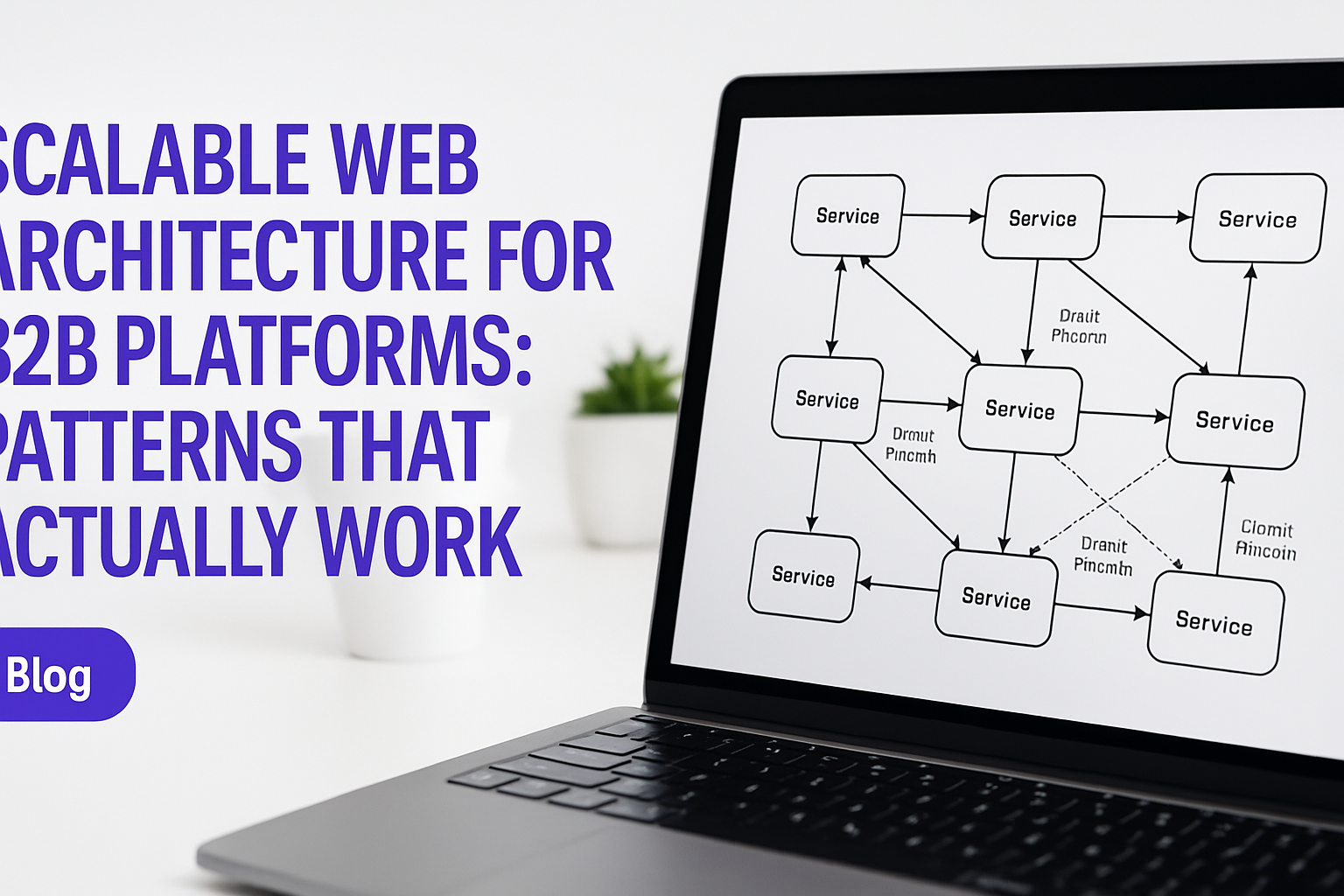
Scalable Web Architecture for B2B Platforms: Patterns That Work
Scalable web architecture for B2B platforms isn't a luxury you add later. It's a set of decisions made at the start that either compound in your favor or compound against you. This post covers the patterns that let you grow from hundreds to millions of transactions without tearing everything down and starting over.
The Architecture Debt That Kills Growth
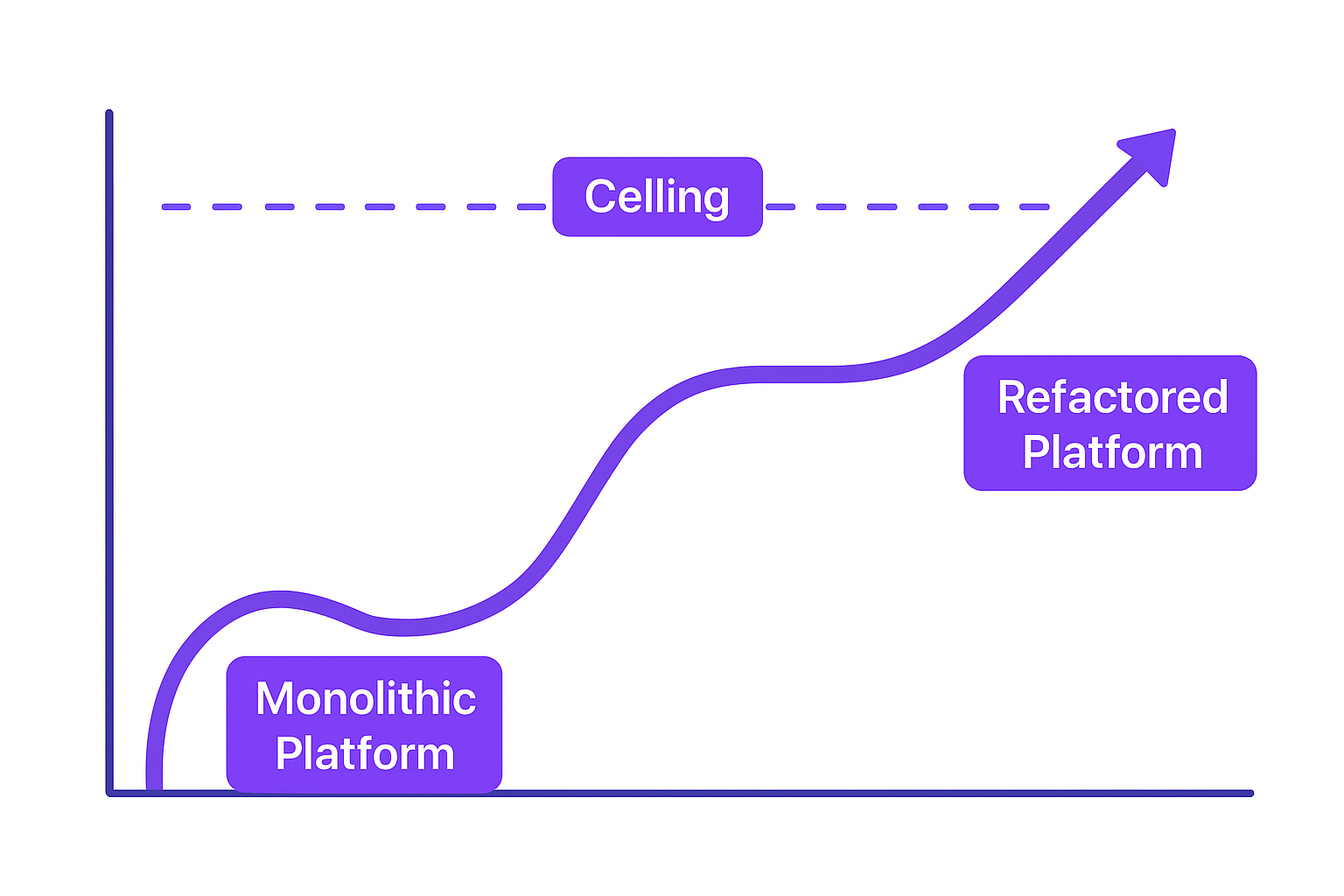
Architecture debt accumulates quietly until it doesn't. Most B2B platforms begin as a monolith: one database, one server, one deploy cycle. That's not a bad decision at the start. It becomes a catastrophic one when nobody revisits it.
You hit 10,000 concurrent users and the whole platform slows to a crawl. You accumulate 100GB of data and queries that once ran in 50 milliseconds now take 4 seconds. Five different teams are trying to ship features at the same time and every merge is a conflict.
The real cost isn't the outage. It's the engineering time. When your team spends 60% of their sprint fighting the architecture instead of building product, you're funding your own stagnation. Every change risks the entire system. Every data migration requires a maintenance window. Every new feature needs a code freeze to coordinate deployments.
Scalability isn't about throwing more servers at the problem. It's about designing a system where growth is predictable and cheap, not chaotic and catastrophic. The Google Cloud Architecture Framework lays this out clearly in its guidance on service decomposition: the cost of change is the metric that matters most.
Why Architecture Decisions Matter Now
The right time to address scalable web architecture for B2B platforms is before you need it. B2B buyers are significantly less forgiving than consumers. A 5-second load time costs you a deal. An hour of unplanned downtime puts a contract renewal at risk.
Your competitors are growing too. If your platform degrades under load while theirs holds steady, you lose on a dimension that no sales deck can recover.
Data volume compounds in ways that sneak up on you. The queries running in milliseconds today will take seconds in two years if the data model doesn't account for growth. AWS Well-Architected Framework identifies query pattern design as one of the highest-use decisions you make during platform architecture. It's difficult to reverse cheaply.
Two other forces make this urgent for B2B specifically. First, compliance and data residency requirements mean you can't always consolidate everything in one region or one database. Architecture must support geographic distribution from the outset. Second, your sales cycle is long. By the time an enterprise customer discovers a performance problem, you're already 8 months into a 24-month contract and your renewal conversation just got harder.
Five Core Patterns for Scalable B2B Architecture
These five patterns appear consistently in well-designed B2B platforms. They're not theoretical. They're the patterns Sam Newman outlines in Building Microservices and the ones teams at GroovyMark WebX apply when building platforms that need to handle real production load.
1. Database Separation by Function
Use a primary database for transactional writes and a read replica for reporting and analytics. This alone takes enormous pressure off your primary. Add a Redis caching layer between your application and the database for frequently read data: session state, user permissions, pricing tables.
The goal is that your most-read data never touches your primary database at all.
2. Horizontal Service Boundaries
Don't split your monolith into microservices because someone told you to. Split when a team is genuinely blocked by another team's ownership of a module. When you do split, one team owns the full lifecycle of one service: its database, its API, its deployment.
Over-splitting creates distributed monolith problems. You still have tight coupling, you just have network latency added on top.
3. Asynchronous Work Queues
Long-running operations belong in background queues, not in the HTTP request path. Exports, report generation, third-party API calls, email sends: all of these should be queued jobs. The user gets a response in milliseconds. The work completes in the background. Your API stays responsive under load.
4. API Versioning and Feature Flags
Never break an existing integration. Version your APIs from day one. When you need to change a contract, publish the new version and give consumers time to migrate. Use feature flags to ship new logic to a subset of users without deploying new code. You get real production testing without risking your whole user base.
5. Event-Driven Data Sync
Instead of service A calling service B directly and waiting for a response, publish an event when something changes. Service B subscribes to what it needs. This decouples systems naturally and lets you add new consumers without modifying producers. It's the pattern that makes adding a new integration later actually manageable.
Implementation Patterns That Reduce Risk
The best architecture implementation starts with the least disruption possible. Begin with a monolith. Add a service boundary only when a team is genuinely blocked. Premature splitting is far harder to undo than late splitting.
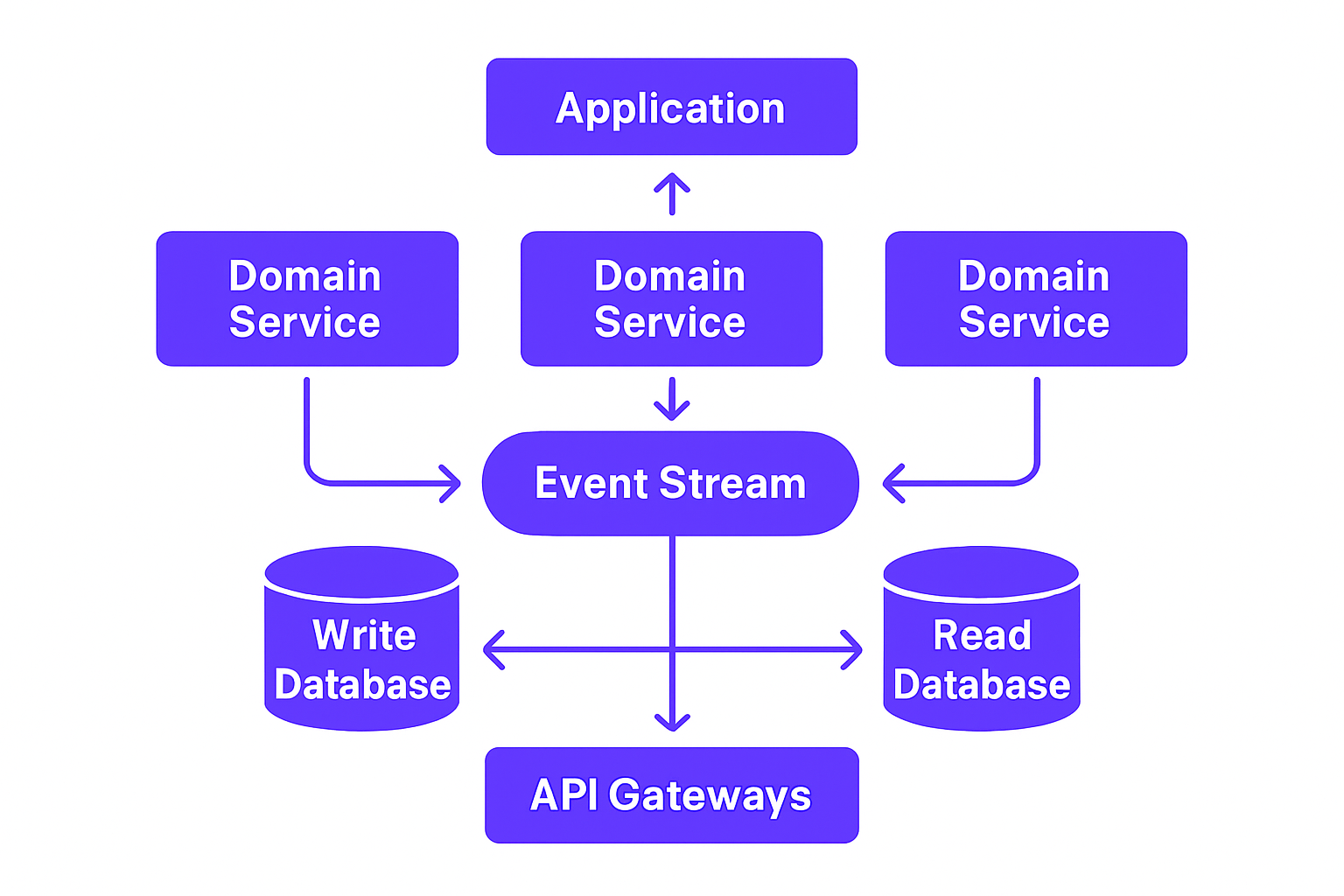
Put a load balancer (nginx or HAProxy) in front of multiple application instances. Keep every instance stateless so any instance can handle any request. Session state lives in Redis, not in application memory.
Implement database connection pooling early. PgBouncer for Postgres, similar tools for MySQL. Without it, 1,000 concurrent users create 1,000 direct database connections and your database server collapses under the overhead before it even processes a query.
Cache aggressively, but invalidate with intention. Use time-based expiry and cache-busting headers. Stale cache data is usually a lower cost than the performance gain from caching. Know the exceptions: permissions, pricing, account status. These need tight cache windows or real-time reads.
Log and monitor from day one. You can't fix problems you can't see. Instrument your critical paths: API endpoints, database queries, background jobs, external calls. Performance regressions should surface in your dashboards before your customers notice them.
Need help building or scaling your B2B platform architecture?
Common Pitfalls That Slow You Down
A few patterns cause more damage than most teams realize before it's too late.
Premature optimization. Rewriting code paths that handle 0.1% of your traffic while the actual bottleneck is three slow queries in your reporting module. Profile first. Find the 1% of queries consuming 80% of your CPU. Fix those.
Over-normalized databases. Third normal form is a starting point, not a law. A few redundant columns in one table can replace five expensive joins. Measure query cost before worshipping the schema.
Synchronous external integrations. If you call a third-party API inside your request path and that API takes 3 seconds to respond, every user who triggers that path waits 3 seconds. Queue the call. Return a pending state. Deliver the result when the background job completes.
No circuit breakers. When a downstream service fails, continuing to send it requests makes it worse and drags your own system down with it. Fail early, return a cached or default response, and recover when the service comes back. The AWS Well-Architected Framework treats circuit breakers as a reliability primitive, not an advanced technique.
Ignoring consistency trade-offs. Distributed systems that optimize for availability often sacrifice strong consistency. That's fine for analytics and view counts. It's not fine for payments, account permissions, or anything that creates a financial obligation. Know where you need strong consistency and design those paths explicitly.
How to Build Scalable Architecture Into Your Platform
At GroovyMark WebX, we build B2B platforms with architecture designed to handle real scale from the first line of code. That means data models, API contracts, and service boundaries scoped so you don't hit a wall at 50,000 users. It means read replicas, caching layers, and background queues are in the architecture diagram before they're in the codebase.
Every platform we ship includes monitoring, logging, and performance baselines. When something degrades, you know exactly which endpoint, which query, and which job is responsible. You're not guessing.
When your legacy systems need to move online, we bridge the old and the new without downtime or data loss. You can see how we approach this in detail on our ERP and legacy system integration service page. It's one of the harder problems in platform engineering and one we've solved across sectors ranging from manufacturing to SaaS.
If you're starting a new platform or scaling an existing one that's showing its limits, contact our team to walk through your current setup. We'll identify the risks, map the bottlenecks, and build a roadmap for 10x growth.
You can also review our case studies from platform builds to see what this looks like in practice.

Every week a scaling problem goes unaddressed, the cost of fixing it grows. Architecture decisions don't get cheaper with time. The right patterns, applied at the right moment, are what separate a platform that grows cleanly from one that requires a painful rebuild at exactly the wrong time.
If you're serious about building infrastructure that supports your commercial ambitions, GroovyMark WebX is the team to have in your corner. We've shipped the systems we're describing here, and we know what the failure modes look like up close.
Let's audit your current architecture and build a scaling roadmap.
Frequently asked questions
When should we move from a monolithic to a microservices architecture?
Move when a single team is blocked by another team's work, not because microservices are trendy. Most B2B platforms scale fine as a monolith up to 50,000+ users. GroovyMark WebX helps you identify the real inflection point and migrates safely when the time is right.
How do we handle data consistency across distributed services?
Use strong consistency for critical paths (payments, accounts, permissions) and eventual consistency elsewhere (analytics, reporting, caches). Implement idempotency keys so retries don't cause duplicates. GroovyMark WebX designs data flows so consistency rules are enforced by the architecture, not by hope.
What's the right database strategy for a scaling B2B platform?
Start with one database and a read replica for reporting. Add a caching layer (Redis) for frequently accessed data. Only split databases by tenant or function when a single database becomes the bottleneck. GroovyMark WebX builds platforms with database architecture that evolves with your growth, ensuring your data stays fast and safe.
How do we monitor and optimize performance in a complex system?
Instrument critical paths: API endpoints, database queries, background jobs, and external calls. Use APM tools (like DataDog, New Relic) to see where time is spent. Profile before optimizing. Most platforms get 80% of their gains from fixing the slowest 1% of queries, not rewriting the application. Every GroovyMark WebX platform includes monitoring and a performance baseline from day one.
What happens when we need to integrate legacy systems into our new platform?
Legacy integration is the hardest part of scaling. You need a bridge layer that translates between your new system and the old one without downtime. GroovyMark WebX specializes in ERP integration and system migration, ensuring data consistency and zero downtime during the transition.