Workflow Automation Using Large Language Models
Large language models aren't chat toys — they're programmable reasoning engines you can wire directly into the processes burning your team's hours. If your ops stack still relies on a human to read an email, classify a support ticket, or pull data from a PDF before anything useful happens downstream, you're paying a tax that no longer needs to exist. This guide covers workflow automation using large language models from architecture patterns to production deployment, with the specificity a senior engineer would actually demand.
Why LLMs Change the Economics of Workflow Automation Using Large Language Models
Traditional robotic process automation was built for structured, predictable inputs. Feed it a form field it doesn't recognize and the whole pipeline stalls. LLMs handle unstructured data natively — free text, inconsistent formatting, multi-language inputs — eliminating an entire class of pre-processing overhead that used to require its own engineering sprint just to get data clean enough to act on.
The Cost-Per-Decision Has Collapsed
Eighteen months ago, routing a support ticket through an LLM cost enough to make a CFO pause. Today, routine classification and summarization tasks run at fractions of a cent per inference call. That shift makes automation viable for tasks that were previously written off as too variable or edge-case-heavy to bother. The calculation has changed: the question is no longer whether you can afford to automate, but whether you can afford not to.
From Rule Trees to Probabilistic Reasoning
Rule-based logic trees require someone to anticipate every branch before a workflow ships. LLMs let you describe the desired outcome and handle the branching implicitly. SaaS and agency teams are already replacing two-to-four FTE-equivalent manual review loops with a single LLM call chained to existing APIs. The concrete ROI shows up quickly: reduced ticket resolution time, faster content operations cycles, and near-zero spend on data enrichment work that used to require a human analyst for every record.
The real shift isn't from manual to automated — it's from brittle, explicit rules to resilient, reasoning-based decisions that get smarter as your eval data grows.
Which Workflows Are Actually Worth Automating With LLMs
Not every process belongs in an LLM pipeline. The first mistake most teams make is reaching for the most impressive-sounding use case rather than the highest-ROI one. The workflows where LLM automation earns its place fastest are high-volume, judgment-heavy tasks that currently sit in a human's inbox: lead qualification, support triage, contract summarization, and onboarding email personalization. These share a common profile — unstructured input, consistent output format required, and a cost-of-error that is recoverable.
The Decision Matrix: Volume, Variability, and Cost of Error
Before committing engineering hours, map every candidate workflow on three axes: how often it runs, how variable the inputs are, and what happens when the model is wrong. High volume and high variability favor LLMs strongly. High cost-of-error — anything legally binding or requiring real-time numeric precision — pushes you toward keeping a human in the loop or deferring automation entirely. An LLM confidently extracting the wrong clause from a contract is worse than no automation at all.
Where LLMs Beat Classical ML — and Where They Don't
Free-text classification, multi-step document extraction, and code review commentary are tasks where classical ML models require expensive labeled datasets and constant retraining. LLMs handle these well out of the box, with prompt engineering standing in for model training. But avoid wiring LLMs into anything requiring real-time numeric precision — financial calculations, scheduling logic with hard constraints — or any decision that carries legal liability without a human sign-off layer.
Auditing Your Stack for High-ROI Candidates
A practical audit takes less than a week. Pull your team's last 30 days of recurring manual tasks. Identify the three that consume the most hours and involve reading or writing unstructured text. Those are your first automation candidates. Our AI automation services we ship to production follow exactly this triage process before a single line of integration code gets written.
Core Architecture Patterns for LLM-Powered Workflows
The architecture you choose determines whether your automation holds up at scale or becomes a maintenance burden by month three. There are three foundational patterns, and the right choice depends on your workflow's complexity and latency requirements.
Single-Shot Inference, Chain-of-Thought Pipelines, and Multi-Agent Orchestration
Single-shot inference — one prompt, one response, one downstream action — is the right starting point for most workflows. It is the easiest to debug, the cheapest to run, and sufficient for 70% of automation use cases. Chain-of-thought pipelines add intermediate reasoning steps, useful when the final output depends on sub-conclusions the model needs to make explicit. Multi-agent orchestration assigns discrete tasks to specialized sub-agents coordinated by a supervisor model — powerful, but only warranted when the workflow genuinely cannot be decomposed into sequential single-shot calls without losing quality.
Tool Use, Function Calling, and RAG
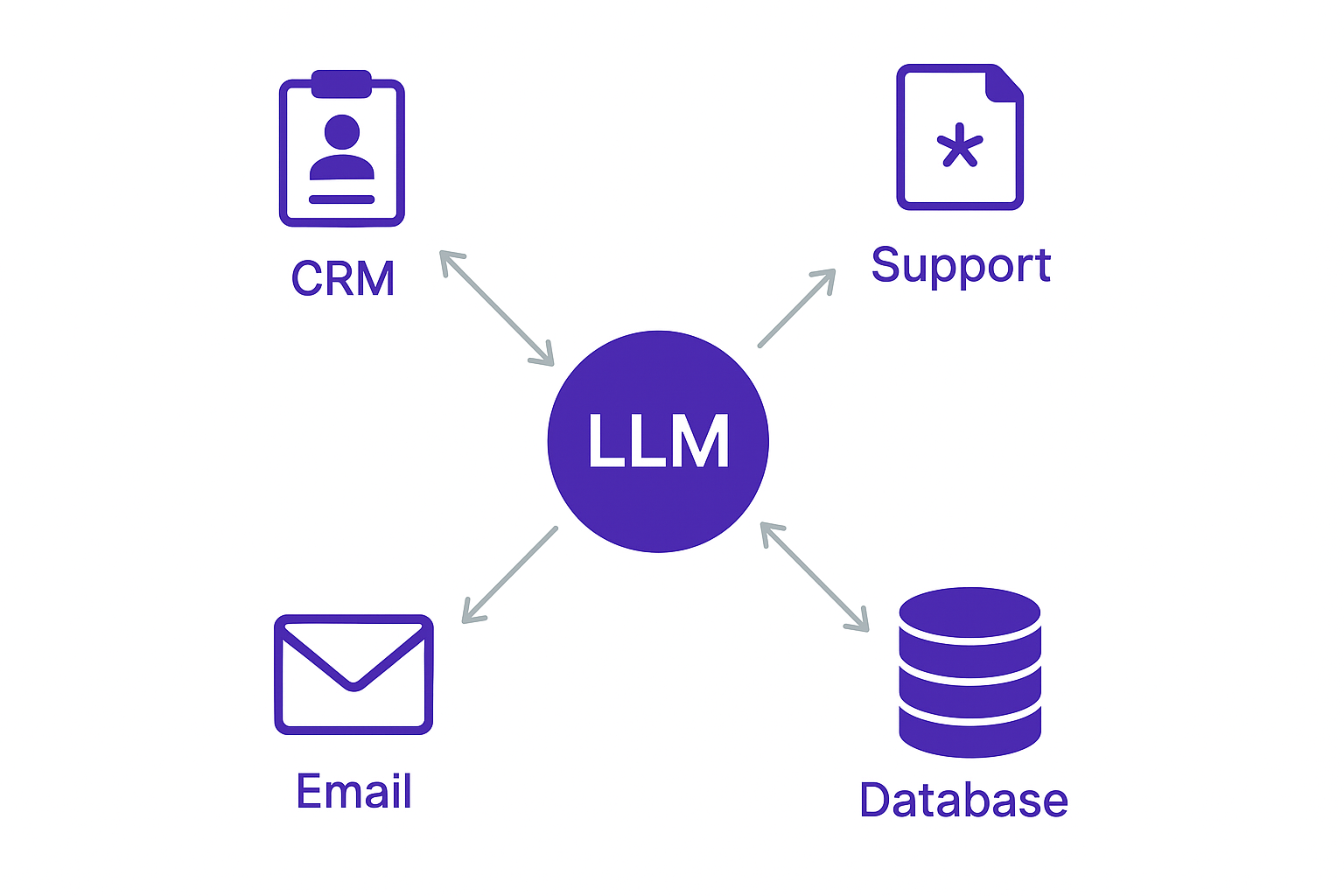
Tool use and function calling let you give your LLM controlled, scoped access to your CRM, internal database, or third-party APIs. Rather than training the model on proprietary data, you define callable functions it can invoke when it needs live information. Retrieval-Augmented Generation (RAG) complements this by injecting relevant context from your knowledge base directly into the prompt at inference time — making it the practical backbone for workflows that require company-specific knowledge without incurring fine-tuning costs. We've documented how we built a RAG pipeline for a SaaS client if you want a concrete reference implementation.
Execution Models, State Management, and Error Handling
Event-driven triggers suit latency-sensitive workflows — a new support ticket fires the triage pipeline immediately. Scheduled batch runs suit throughput-heavy jobs where a few minutes of lag is acceptable. Between calls, stateless design fails at scale because the model has no memory of prior steps; persist context explicitly using a lightweight state store so multi-step workflows don't degrade midway. Critically, build confidence thresholds into every workflow: when the model's output falls below a defined certainty threshold, it hands off to a human rather than acting on a low-confidence decision. That fallback path is not optional — it is what makes the system trustworthy enough to run without constant supervision.
Stack Recommendations: Tools and Models That Ship to Production
Choosing the right model and orchestration layer is not a philosophical debate — it is an engineering decision with real cost and maintenance implications at production scale.
Model Selection by Use Case
GPT-4o handles complex multi-step reasoning and tool use reliably and is the default choice for workflows where reasoning quality directly affects output value. Claude 3.5 Sonnet has the edge on long-context document work — processing entire contracts or large knowledge bases in a single pass without degradation. Open-source Llama 3 variants (deployed via Ollama, vLLM, or a cloud provider's dedicated endpoint) make sense for cost-sensitive, high-volume workloads or any scenario where data cannot leave your infrastructure. The rule: always benchmark against your own eval set before committing to any model, because benchmark leaderboard rankings rarely reflect your specific task distribution.
Orchestration Layer Trade-Offs
LangChain ships with the broadest set of integrations and is useful for prototyping quickly, but its abstraction layers introduce debugging complexity that costs you at scale. LlamaIndex is better scoped for document-centric RAG workflows. For most production systems, a thin custom wrapper around the model provider's SDK — with explicit prompt templates, retry logic, and structured output parsing — is more maintainable than either framework. The overhead of building it is three to five days; the maintenance savings over six months make it the senior engineer's default. You can start with LLM integration resources and starter templates to reduce the initial build time.
Infrastructure Defaults That Hold Under Load
Async queues — BullMQ in Node environments, Celery in Python — decouple workflow triggers from inference execution and give you natural retry and backoff behavior. For vector stores, pgvector is the right default if you already run Postgres and your query volume is moderate; Pinecone or Weaviate earn their place when you need sub-100ms retrieval at millions-of-vector scale. Observability is non-negotiable: instrument every LLM call with prompt version, token count, latency, and model response before you ship anything to production. Prompt versioning and a maintained evaluation set are the two artifacts that separate a workflow you can iterate on from one you're afraid to touch.
Implementation Playbook: From Proof of Concept to Live System
A clear week-by-week structure prevents the two most common failure modes: building before you understand the problem, and polishing before you have signal.
Week 1: Define the Boundary and Build the Eval Set
Write down the workflow's exact inputs, the exact outputs required, and the criteria that distinguish a correct output from an incorrect one. Collect 50 to 100 real examples from your existing operations — not synthetic ones. These become your evaluation set, and without them you have no basis for calling anything "working." Do this before touching any code. The teams that skip this step ship faster and redeploy more.
Week 2: Build the Minimal Inference Layer
Build the smallest possible system that processes your eval set end-to-end: prompt template, model call, output parser, logging. No UI, no admin panel, no polish — only signal. Run your evals. Iterate on the prompt and output schema until your precision and recall on the eval set justify moving forward. Instrument every call with structured logs from day one, because the debugging data you capture now will save you days in week three.
Week 3: Integrate, Stress-Test, and Deploy
Connect upstream triggers — webhook, queue consumer, cron job — and downstream outputs — API write, database update, notification. Then stress-test with production-scale payloads, not synthetic load. Before shipping, run through the full deployment checklist: rate-limit handling, hard cost caps on token spend, PII scrubbing in the prompt construction layer, human-override hooks for low-confidence outputs, and a complete audit log of every model decision. Measure success against three north-star KPIs: precision/recall on classification tasks, time saved per workflow run, and error escalation rate. The most common launch mistakes are shipping without evals, ignoring token cost at scale, and building exclusively for the happy path.
Real-World Use Cases Delivering Measurable Outcomes
Patterns from real deployments are more instructive than architecture diagrams alone.
Support Triage, Content Ops, and Onboarding Personalization
A B2B SaaS support team implemented an LLM triage layer that read incoming tickets, classified them by issue type and urgency, and routed them to the correct queue while drafting an initial response. First-response time dropped 68% and 40% of tickets were fully deflected before a human agent was involved. A digital agency's content operations team automated the brief-to-outline pipeline: the LLM read a client brief, queried relevant research sources via tool calls, and returned a structured content outline. The research phase went from three hours to 22 minutes per piece.
Lead Enrichment and Onboarding Activation
A SaaS company wired user behavior data from their product analytics platform into an LLM pipeline that generated personalized in-app guidance for each user's activation path. Thirty-day activation improved by 19 percentage points. An outbound sales team replaced a manual SDR enrichment task — reading company websites and LinkedIn pages to write personalized outreach context — with an LLM-powered research pipeline. Each rep recovered four hours of selling time per week.
The pattern across all four cases is identical: the automation worked because the workflow boundary was narrow and explicit, the eval set was built from honest real-world examples, and the fallback path to a human was designed before the happy path was built.
Where LLM Workflow Automation Is Heading in the Next 12 Months
The current wave of single-workflow automation is the foundation, not the ceiling.
Agentic Loops and Expanding Context Windows
Multi-agent systems are maturing from experimental to production-viable. Expect architectures where specialized sub-agents own discrete workflow steps — one agent handles data extraction, another handles classification, a coordinator routes between them and resolves conflicts. Simultaneously, model context windows expanding past one million tokens fundamentally redefines what "document processing" means. Entire contract histories, codebases, or customer conversation archives can pass through a single inference call, collapsing pipelines that previously required chunking and retrieval workarounds.
Cost Curves and Regulatory Pressure
Inference pricing has dropped approximately tenfold in 18 months. Workflows that were cost-prohibitive in 2023 are table stakes by the end of 2025. That cost curve accelerates adoption, but it also accelerates regulatory scrutiny. Governments across the EU and increasingly in North American jurisdictions are moving toward mandatory audit trails for AI-automated decisions affecting customers. Build that audit infrastructure now — it is far cheaper to instrument from the start than to retrofit into a system already running at scale.
The Competitive Moat Has Already Shifted
The teams that will be difficult to displace are not those who adopted AI first — they are the teams accumulating proprietary evaluation data and domain-specific fine-tuned models that no competitor can replicate quickly. "We use AI" is no longer a differentiator. A curated eval set of 10,000 real workflow examples from your specific domain, paired with a fine-tuned model trained on your outcomes, is. Start building that asset today, even if your current system uses zero fine-tuning. The same-week landing page launches with AI-generated copy approach we apply to front-end work reflects the same principle: move fast on execution, invest deliberately in the proprietary layer that compounds over time.